Blogs
Build a Feature Flag System in 50 Lines with Rails.app.creds | Code With Rails
You don’t need LaunchDarkly. You don’t need Flipper. For most Rails apps, you need feature flags that are version-controlled, easy to override in development, and don’t require another service to manage.
Rails 8.2’s Rails.app.creds gives you exac...

Ruby Can Draw Cities Now – Now open for 2026 sponsorships
How I built a pure-Ruby GIS engine that renders Paris, Tokyo, New York, and more
Most people don’t think of Ruby when they think about maps, GIS, or visual computing. If you want to draw a real city, the standard stack usually looks like:
QGIS
Po...

Bridgetown 2.1 Has Come to Town! Happy Holidays 🥳 | Bridgetown
You better watch out (I’m telling you why): the latest release of our merry little Ruby framework is coming to town! Yes indeed, Bridgetown 2.1 “Festive River City” is here, with a marquee feature enabling you to load in wiki-style content & “digi...
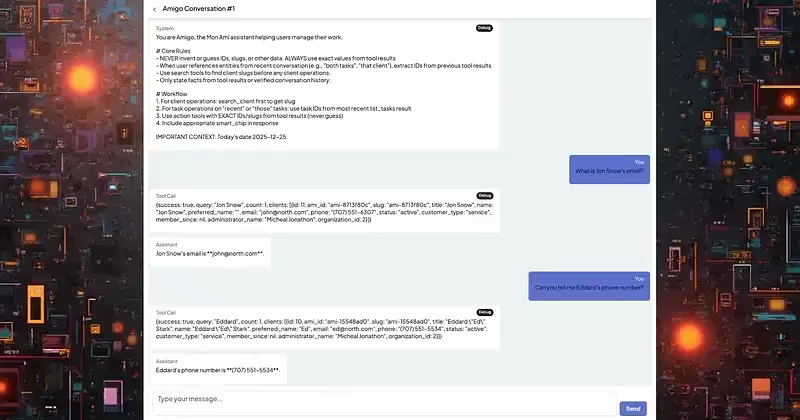
Building an AI agent inside a 7-year old Rails application
I’m a Director of Engineering at Mon Ami, a US-based start-up building a SaaS solution for Aging and Disability Case Workers. We built a large Ruby on Rails monolith over the last 7 years.
It’s a multi-tenant solution where data sensitivity is cr...

ZJIT is now available in Ruby 4.0 | Rails at Scale
ZJIT is a new just-in-time (JIT) Ruby compiler built into the reference Ruby implementation, YARV, by the same compiler group that brought you YJIT. We (Aaron Patterson, Aiden Fox Ivey, Alan Wu, Jacob Denbeaux, Kevin Menard, Max Bernstein, Maxime ...

Rebuilding Ruby’s Image Processing Layer: Why ruby-libgd Matters for GIS and the Future of Ruby
In late 2025, during a RubyConf presentation about disaster-response systems, an uncomfortable truth was stated publicly:
Generating map tiles and images on the server is difficult in Ruby. RMagick and MiniMagick were too slow. ruby-gd is used, b...

Stepped Actions: workflow orchestration for Rails - Klevo
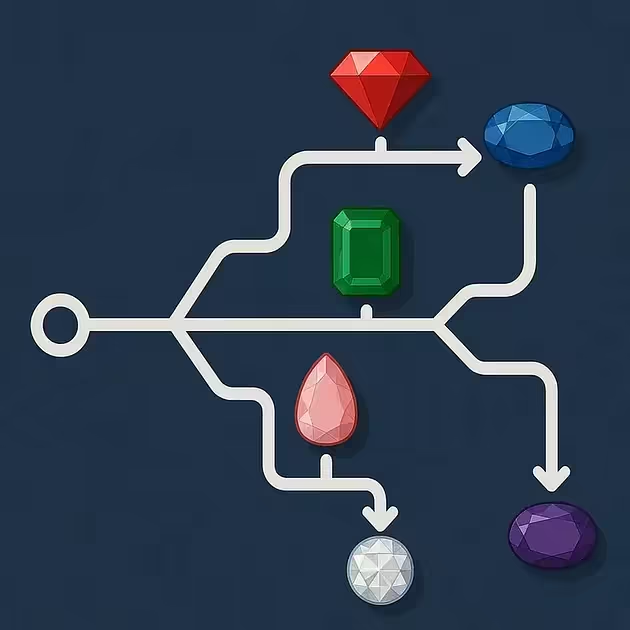
Stepped is built around a few ideas that I have wanted in Rails for a long time:
Action trees: a root action runs step-by-step and each step can fan out into more actions.
Concurrency lanes: actions share a concurrency_key so work runs one-at-a-t...
Lessons learned from studying Fizzy test suite | Test Driving Rails Blog
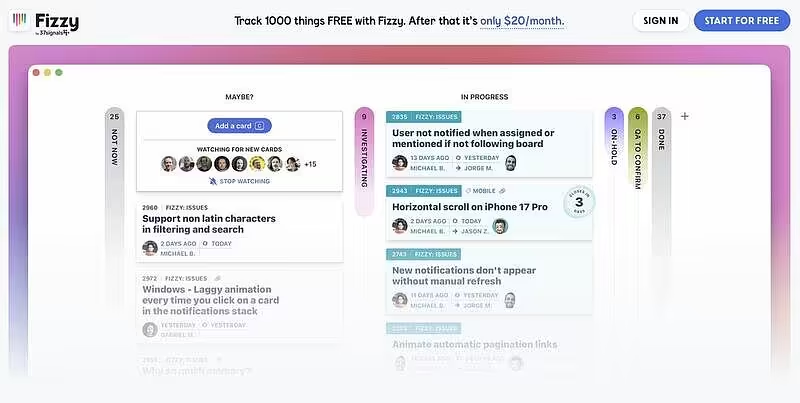
The Fizzy application is a new play on Kanban board and project management. It has a comprehensive test suite focused mostly on unit and integration tests, althought other types of test are also present. The test suite is well-organized and follow...
Visit our blog